
Vabadus on hindamatu
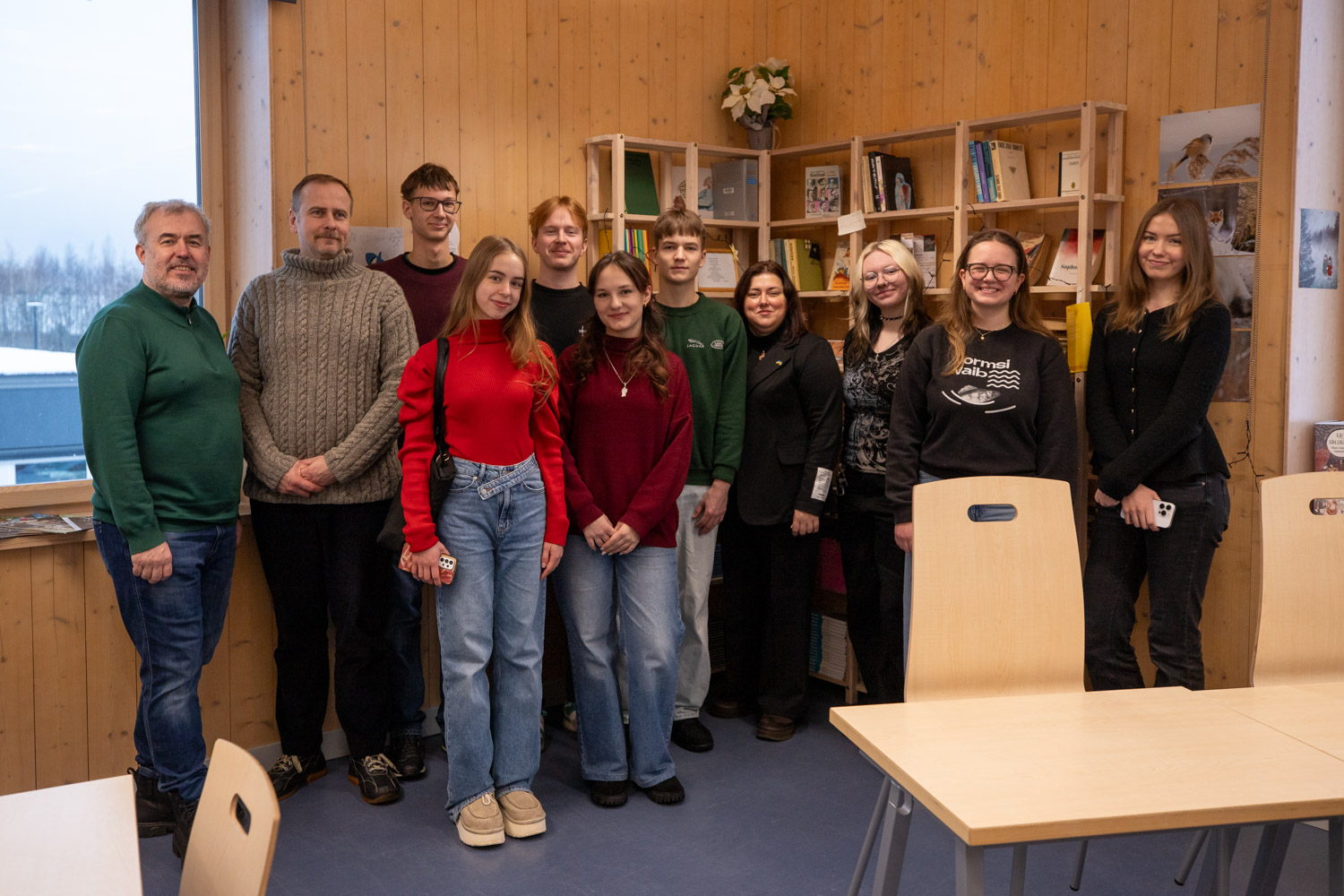
26. jaanuaril külastasid meie toimetust neli särasilmset ukraina noort: Alisa Petrova, Maksym Spivakov, Ivan Ivanisov, Viktoriia Bashynska. Nad olid meievanused, mõni isegi noorem. Samad unistused, soovid, mõtted, lihtsalt teine asukoht siin planeedil. Järgnevalt on jagatud iga noore kirjeldust tema tavapärasest koolipäevast. Olgu need read meile kõigile meeldetuletuseks iseseisvuse ja vabaduse väärtusest.
Sissejuhatus: Laura-Lisett Lugu
Tekst: Alisa Petrova, Maksym Spivakov, Ivan Ivanisov, Viktoria Bashynska
Alisa Petrova
My name is Alisa Petrova. I study in the 9th grade at the Cherkasy Scientific Physics and Mathematics Lyceum, and I am the Vice President of our student council.
My weekdays begin even before the school bell rings. I wake up, check my messages, get ready for the day, and think about what awaits me today. Sometimes, on the way to school, you can already hear an air raid siren, and we have to wait or slightly change our route, because lessons start only after the alert ends.
At school, the day consists of lessons, breaks, and small moments that make it feel alive. Mathematics, literature, history — everything seems usual, but there is always room for something unexpected: new topics, discussions, funny jokes from friends, and small victories on tests.
Our school also has a mixed schedule. We study in person for two weeks and then remotely for one week, and this system alternates. Not all students can attend school at the same time, because the bomb shelter does not have enough space for the entire lyceum. Because of this, the learning process often feels fragmented and requires extra effort from both students and teachers.
Because of air raid alerts, we sometimes miss part of a lesson, and then we have to catch up on the material on our own or study in a bomb shelter. There, we manage not only to learn, but also to talk, support each other, and sometimes even relax a little — someone brings a new game, someone tells a funny story, and the atmosphere immediately becomes lighter.
Even despite sirens and power outages, we are able to find happiness — in communication with each other, in humor, and in small joys. We see light in one another, even when there is none around us. These moments create the feeling that, despite all the difficulties, life goes on, and friendship and support remain constant.
I return home, and often I am greeted by darkness. There is no electricity, no usual comfort. But I still try to do my homework, prepare for the next day, and look for small moments of joy in ordinary things: coffee, music, conversations with my family. Sometimes I open the window, look at the evening sky, and feel that the day, although exhausting, was still full of life and small victories.
My weekdays are not just lessons and school bells. They are a rhythm of life in which challenges, hope, and the habit of not giving up are constantly intertwined. It is day after day that teaches endurance, patience, and the ability to value even the smallest joys. And it is in this that I find the strength to keep going, no matter what.
After the trip to peaceful Estonia, we felt the difference between the two realities especially strongly. There, silence is normal, light and warmth need no explanation, and calmness does not seem like a luxury. While returning to Ukraine by bus, we talked a lot about this.
The conversation on the road was quiet and honest. We realized that we were going back to a world where the lack of light, warmth, and silence has become part of everyday life. A world where calm is not the background of life, but a short pause between air raid alerts.
This contrast did not break us, but it made us understand the value of peace even more deeply. We returned changed — with a clear sense of what is worth holding on to, studying for, and continuing to live for.
If you have any questions or would like to connect, feel free to reach out to me on Instagram (@aelis.voice)
Ivan Ivanisov
I study at Zaporizhzhia Academic Lyceum No. 93 of the Zaporizhzhia City Council. I am in the 10th grade. My city is close to the frontline, and here the war is not something distant — it is part of everyday life, especially when we attend school in person.
Our learning is mixed: one week online, one week at school. But school is no longer a place of safety or calm. At 8:00 a.m. we do not go to regular classrooms — we go straight to the bomb shelter. This is where our lessons take place.
At 9:00 a.m. the entire school stops for a minute of silence to honor those who were killed in the war. In this moment, the silence feels heavy and frightening. Everyone understands why it exists. It reminds us that the danger is real and very close.
Around noon, at about 12 o’clock, we receive lunch in disposable containers. The food is diet-based — without sugar, salt, or spices. It tastes almost empty, but during the war even food loses its importance. Fear overshadows everything.
Lessons are not the same as they used to be. We try to study, but in reality we are constantly tense. Students and teachers listen to every sound, watch the windows, check the news. Any sudden noise makes us freeze. Fear becomes a constant background — something you cannot get used to.
The most frightening moment comes at the end of the school day. Going home feels terrifying. Recently, Russia has been attacking Zaporizhzhia even in broad daylight. When you leave school, you never know if you will get home safely.
And if an air raid siren starts at that moment, panic takes over. Your heart races, your thoughts get confused, and only one idea remains: to survive and reach home as quickly as possible.
This is what my education looks like during the war.
It is scary here.
And this is our reality.
Maksym Spivakov
My day starts by checking the map of air alerts in Ukraine. Sometimes my mom does it for me because I may sleep. If it is morning, students stay at home until the alert, then we go to school. In other situations, when we are at school, we go to a shelter even if we have no electricity. Because safety above all else.
In general, some days might seem boring, but often the student council creates events there (I am the president of my school). Now, we are preparing for Valentine's Day. What do we think about doing? My idea is to create many Valentine's hearts from paper, cut them up into two pieces, mix all of them, and give them to somebody at school. Two strangers have to find each other and meet. It could be anyone at school from 5th to 11th grade, so I suppose it is a genius idea to meet people.
Our lessons hold 45 minutes, and break around 10- 20 minutes, also depending on the part of the day. We have an e-dictionary where teachers put their marks.
After class, I go to a gym or walk with friends. Yeah, I'm kinda a busy guy.
Overall, when I was in Estonia, I saw that some parts of the school day were different. First, your building and equipment are better, and in conclusion, you can have more practice lessons instead of just listening to the teacher. Second, I liked how people connect in your society and what they wear. They can show themselves as they want and aren't afraid of what someone says.
All in all, I want that country to keep in touch and support each other. I like this project sort of Erasmus+ or just a youth exchange. If you have more questions, you can write to me on Instagram (my nickname is Maksytka), and I will answer. I am also keen on knowing about other countries and searching for internet friends.
With the best wishes,
Maks
Viktoria Bashynska
Well, my everyday student life.
I’m Viktoria, a first-year law student at Zhytomyr Polytechnic State University. And although I never thought I would study law, now I do not regret my choice. It is a good opportunity to become a specialist in my field and bring positive changes in my country.
As for the learning process itself, it is a little different from what it was in high school. We come to classes at different times — either in the morning or closer to the evening. We usually have 2-3 classes a day, but starting this semester, we will have 4 classes most days. Although my city is not in the frontline zone, we also often suffer from air raid sirens and drones. However, this does not prevent us from studying — if the alarm ends before the start of classes, we go to the university, and otherwise, we switch to online learning.
Our student government and the university administration are focused on the development of students, our university, and the creation of comfortable conditions for learning. For example, the student council organizes interesting events on various holidays (on Halloween we were able to come in costumes, on New Year's Eve we held master classes on making Christmas spiders (our Ukrainian tradition) and organized a movie screening). We also have birthdays of our faculties, and according to student tradition, each celebration lasts a week, and students from the birthday faculty prepare a photo zone and other cool activities.
Our student family has students who joined the Armed Forces of Ukraine and, unfortunately, have already died. There are active defenders and veterans who continue to live and receive education.
Being in Estonia, we felt like we had entered another universe, where your life does not depend on power outage schedules and a neighboring country. Nevertheless, these few days of our trip were filled with positivity, new acquaintances, and knowledge, for what we are really thankful.
If you have any questions or just want to get acquainted and chat, I will be happy to answer on Instagram (nickname: @_bashinskaviktoria_)🩷